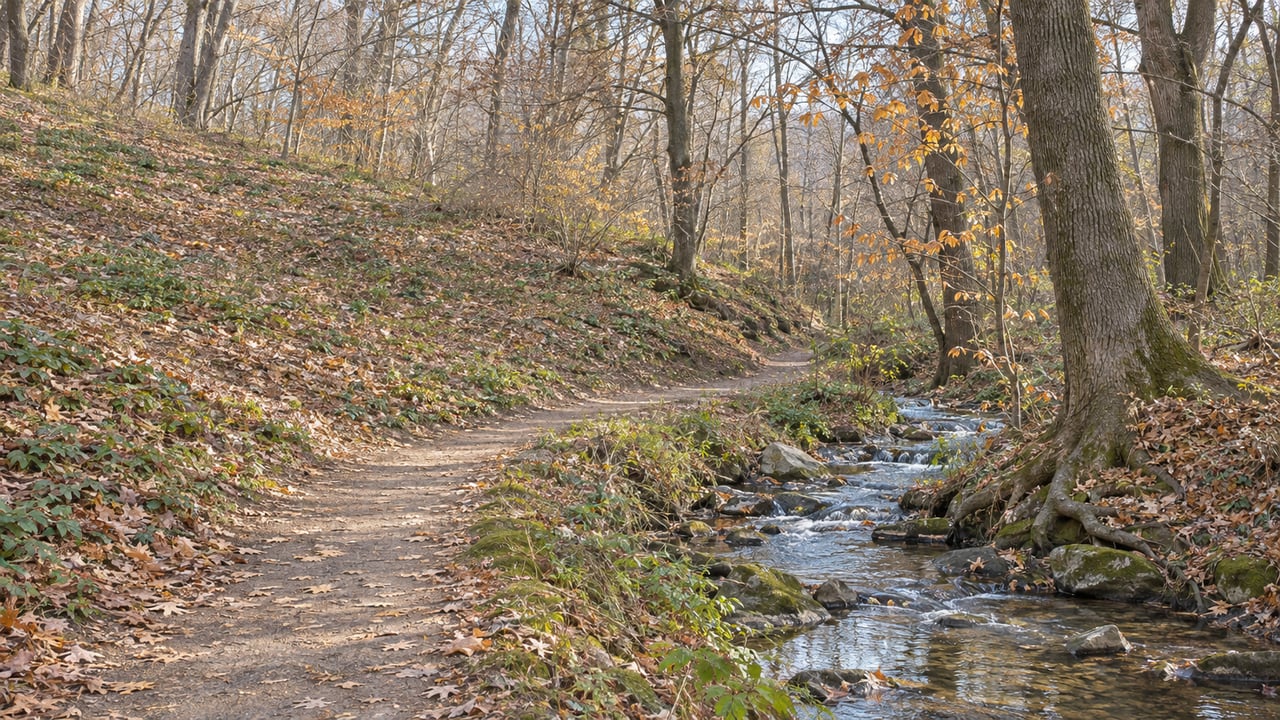
After a rain or a snowmelt, water stands on the brick sidewalks of Newark Street, and in cold weather it turns to ice. According to the Rosedale Conservancy, that water comes from the conservancy's own lawn. Rosedale sits at the highest point in this part of Cleveland Park. Its two bowling greens hold storm water and let it out slowly toward Newark Street. From there the water goes underground beneath the houses and comes back up east of Macomb Playground. It then runs behind Macomb Street, along the northern edge of Tregaron, and down to Rock Creek.
So the two green spaces Cleveland Park neighbors saved, a farmhouse lawn on Newark Street and a 13-acre wooded former estate off Macomb Street, sit on the same stream. One is the headwaters and the other is the valley. That makes a good route for a long holiday weekend with family in town. Start at the top and follow the water down to Rock Creek Park.
Rosedale Is Where the Stream Begins
Rosedale's three acres of terraced lawn are open to the public. The grounds open at 7 a.m. on weekdays and 8 a.m. on weekends, and they close every evening at dusk. Use the gate at Newark and 35th Streets, where the conservancy held its pumpkin patch on October 24. The lawn has had no entrance from Ordway Street since 2013. Before that, a neighbor let people cross the empty lot east of the farmhouse, but the lot was sold that year and a house went up on it.
The stream also explains the rule that confuses the most visitors. Rosedale stays closed after the rain stops. The lawns sit on clay soil that holds water and drains slowly. The conservancy says closures are most common in winter, when the grass is dormant and wet spots form that foot traffic, human or canine, can easily damage. The features in front of the farmhouse were shaped by landscapers more than 200 years ago. They include ramps, bowling greens and falls, and the conservancy says only a few remaining landmarks in the mid-Atlantic still have them. If this week turns wet, check the conservancy's site before you bring guests to the gate.
The rest of Rosedale's rules come from the fact that volunteers run it. There are no trash cans. Newark Street is not a bus route, so the city doesn't collect there, and the conservancy asks visitors to pack out what they bring in. Dogs need a member's registration and a current Rosedale-issued tag, and they are allowed only during off-leash hours. Now that standard time is back, those hours are 7 to 11 a.m. and 3 to 6 p.m. on weekdays, and 8 to 11 a.m. and 3 to 6 p.m. on Saturdays and Sundays. If your visiting relatives brought a dog without a tag, plan to walk it at Tregaron, where leashed dogs are welcome. Rosedale membership costs $100 a year. The conservancy is funded entirely by community support, and that money pays for grounds upkeep and the free events, including the pumpkin carving, the Easter egg hunt and concerts.
The newest work is along the fence. In spring 2025, a third phase of planting cleared invasive plants from the western end of the fence line, put down biodegradable erosion-control material, and added native plants and shrubs next to the first phase. The two earlier phases are by the driveway and sign and east of the pedestrian gate.
The Lawn Is Public Because Neighbors Matched a $12 Million Contract
The farmhouse is a private residence, so admire it from the lawn. Its history is a good story to tell guests from a distance. The conservancy dates the original stone cottage to the 1730s. Uriah and Rebecca Forrest bought the property in 1793 and built the 1794 frame house that became part of today's farmhouse. The house and grounds were named to the National Register in 1973.
The lawn is public because of what neighbors did in 2002. Youth for Understanding, which then owned the six-acre estate, signed a $12 million contract in June 2002 to sell it to an independent school. A covenant from the late 1970s gave the owners of about 18 neighboring properties 90 days to match any sale. Over that summer, the neighborhood raised the money. On September 3, 2002, the covenant holders voted unanimously to match the contract. The school asked the seller's bankruptcy court to reject the match, and after a day-long hearing with neighbors in the gallery, the judge upheld the neighborhood's right to buy. More than 100 families contributed to the purchase.
Under the plan that followed, three five-story dormitories came down. The land north of the lawn was divided for seven new houses, one on each side of the farmhouse and five along Ordway Street. The front three acres went to a land trust that the neighborhood created and manages. The conservancy says that historic easement and the landmark designation are why it restricts use after storms.
Down Macomb Street, the Water Surfaces at Tregaron
From Rosedale, walk downhill toward Macomb Playground, where the spring comes back above ground. The main Tregaron entrance is a short walk east at 3100 Macomb Street NW. A second main entrance is on the 3000 block of Klingle Road NW, and two more open from the Klingle Valley Trail.
Tregaron has its own version of the Rosedale story. The Parmelees bought the estate in 1911. In 1980, the Tregaron Limited Partnership and Washington International School bought the property together and split it. The partnership tried several times to develop its share. Friends of Tregaron led the opposition, and the Historic Preservation Review Board found the plans incompatible. A 2006 agreement among the three parties ended the dispute. Ten acres went to a new Tregaron Conservancy, three more went to the school with a commitment to keep them open space permanently, and limited residential development helped fund the conservancy. The conservancy was founded in January 2006.
Today, the conservancy owns and cares for 13 acres of the original 20-acre estate. The grounds are free and open every day from dawn to dusk, and private donations pay for them. The school's roughly six acres on the hilltop are closed to the public. On the conservancy's land you'll find a lily pond, two streams, fields, meadows, stone bridges, stairways and footpaths. The main trail is the Bridle Path, which the estate's original designers kept as the backbone of their path plan.
What Twenty Years of Digging Put Back Along Klingle Stream
Much of the conservancy's restoration has happened along Klingle Stream. In 2019, the conservancy uncovered the original cobblestone edges of Klingle Stream. They also began recreating landscape architect Ellen Biddle Shipman's footpath around the Lily Pond, which dates to about 1915. The conservancy is restoring the Klingle Stream Valley from the Causeway bridge to the Klingle Stream headwall. That work includes clearing invasives, restoring the stream bed and its stone bridges, and planting in Shipman's style, with hundreds of daffodils along the stream for early spring color.
The meadow is the clearest example of how long this work takes. Before 2017, the whole area was covered in invasive species. It is now a native grass and wildflower meadow designed by meadow specialist Larry Weaner, kept up with strict mowing and regular new plantings of native grasses, sedges and wildflowers. As of its projects update last November, the conservancy had planted more than 300 native trees, many of them with Casey Trees. It has also hired a civil engineer to study the storm water that erodes its trails and slopes.
At Tregaron, the conservancy recommends sturdy closed-toe shoes because the mulched trails are uneven. Dogs must be leashed. Bikes are not allowed anywhere inside the conservancy, and some areas may close temporarily. The most recent program was a bird walk on November 1 that met at the Macomb Street entrance.
Out to Rock Creek on the Klingle Valley Trail
Below Tregaron, the route reaches the Klingle Valley Trail. It is a paved 0.7-mile trail that opened in 2017, is managed by the District Department of Transportation, and links Cleveland Park and Woodley Park to the Rock Creek Trail and Tregaron. As Greater Greater Washington described it when it opened, the trail runs between Cortland Place NW and Porter Street NW and passes under Connecticut Avenue on its way to the Rock Creek multi-use trail. Unlike the paths inside Tregaron, it is paved. That makes it the easier section for strollers and for relatives who would rather skip the mulched slopes. For what sits at the Woodley Park end, see our recent look at Woodley Park.
At Rock Creek, plan around the season. Since November 2, the National Park Service has been closing some park roads and trails at night for deer management. Staff, signs or temporary barricades mark the closed areas, and the park asks visitors to follow posted detours. The Nature Center and Planetarium remain closed until further notice. With Rosedale and Tregaron both closing at dusk, an early-afternoon start lets you walk the whole route in daylight.
The Route, Top to Bottom
For a Friday or Saturday after Thanksgiving dinner, the order that follows the water is:
- Rosedale, through the Newark and 35th Street gate. Weekend hours start at 8 a.m., and the grounds may be closed after rain.
- Downhill past Macomb Playground, where the Rosedale spring resurfaces.
- Tregaron's Macomb Street entrance at 3100 Macomb Street NW, then the Bridle Path, the Lily Pond and the restored stretch of Klingle Stream.
- Out through a Klingle Valley Trail entrance, then under Connecticut Avenue on the paved trail.
- Rock Creek Trail, ending before dusk and staying out of any marked closures.
Both conservancies post closures and events on their own sites, Rosedale's here and Tregaron's here. Rosedale's grounds are the most likely to be shut after a wet week. For more on the neighborhood around this route, see our Cleveland Park guide and our earlier post on the Uptown Theater block on Connecticut Avenue.
If you live near Rosedale's gate or Tregaron's Macomb Street entrance and are thinking about your next move, Abrams Residential would be glad to talk it through. Schedule a complimentary home strategy consultation.